
Dany Lee's Trompe L'Oeil Moment
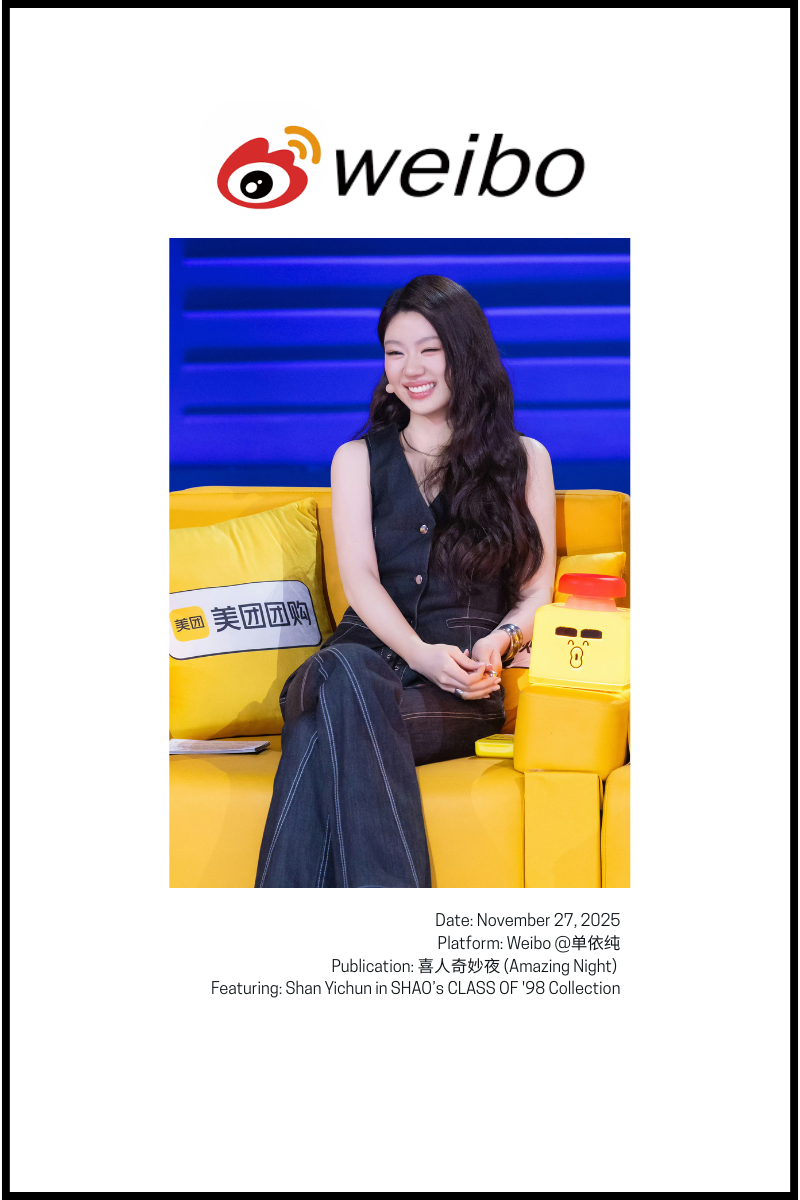
Dany Lee's appearance on Douyin Stand-up Comedy Livestream wearing SHAO's Chartreuse Trompe L'Oeil Blazer – Vest Overlay Construction from the Shanghai 1930's series marks more than a styling choice—it represents the collision of China's streaming entertainment culture with historically-informed fashion design that refuses nostalgic literalism.
The blazer itself operates in that narrow space between historical reference and contemporary wearability that most designers either overcomplicate or oversimplify. SHAO's approach to the 1930's series acknowledges Shanghai's position as Asia's fashion capital during that era without reproducing qipao clichés or falling into the trap of "Shanghai decadence" costume drama aesthetics that plague period-inspired Chinese fashion.

The Deconstruction Conversation
Deconstruction has moved from ’90s conceptual experimentation to today’s trend-driven “raw edge” aesthetics, but SHAO’s approach stands apart. For SHAO, deconstruction isn’t decoration—it’s structural intelligence. The green blazer Dany Lee wears from the SHANGHAI 1930’s series exposes only the details that serve purpose, revealing how the silhouette works without compromising performance-ready wearability.
On Douyin, where vertical framing, mobile screens, and zoomed-in screenshots shape how outfits are consumed, clarity matters. The chartreuse green answers this directly: vivid enough to register instantly in algorithm-driven feeds, yet refined enough to support the performer rather than overpower her. It’s deconstruction built for modern visibility—precise, functional, and unmistakably SHAO.

Performance Context and Power
Dany Lee’s choice of the SHAO SHANGHAI 1930’s deconstructed blazer for Douyin Stand-up Comedy Livestream carries real cultural weight. On Douyin, where music shows shape careers and visual identity is read as artistic intent, wardrobe becomes more than styling—it signals genre alignment, creative philosophy, and audience awareness.
By selecting a piece rooted in historical reference yet structurally reimagined, Dany Lee positions herself similarly: grounded in musical craft but open to contemporary experimentation. The blazer becomes a visual metaphor for her artistic stance—respectful of tradition, but unwilling to be confined by it.
The “effortless aura” is not accidental. Making a tailored garment appear unconstructed while remaining fully functional requires deep technical understanding. SHAO’s deconstruction preserves essential structure while creating movement and ease, allowing the blazer to perform under the demands of live camera work.
As Dany Lee moves, the piece moves with her—fluid, responsive, and controlled. This balance mirrors live music itself: precision held lightly, expression guided rather than constrained.

The Streaming Platform Context
Douyin isn’t just a platform—it’s one of the most powerful engines of fashion visibility in China. Shows reach audiences far beyond traditional fashion media, meaning what performers wear becomes cultural currency, not editorial content. Viewers encounter Dany Lee’s chartreuse blazer in motion, in performance, without the framing of stylists’ notes or fashion commentary—fashion functioning as character-building, not promotion.
SHAO’s design meets this reality with precision. The blazer reads instantly on camera, supports movement, and delivers impact, yet maintains structural intelligence that holds up under close digital scrutiny. It’s performance-ready without becoming costume, design-forward without becoming inaccessible.
Douyin’s vertical video format also reshapes how garments must function. With the frame focused on the upper body, blazers become visual anchors. SHAO places its deconstructed elements exactly where the camera lingers, ensuring the piece remains compelling whether viewed full-screen or paused mid-gesture. It’s fashion engineered for contemporary viewing—clear, intentional, and deeply aware of its medium.

What Television Performance Teaches Design
Dany Lee’s use of the SHAO blazer highlights what television and streaming truly demand from fashion—demands the runway rarely has to answer. Performance garments must move cleanly, read clearly on camera, hold shape under heat and lighting shifts, and survive digital compression without losing color or structure.
These aren’t constraints; they’re design realities. SHAO’s blazer succeeds because it’s built with these conditions in mind. The deconstructed structure isn’t theatrical—it’s functional. It adapts to motion, registers crisply on vertical video, and maintains integrity across a livestream’s full runtime. This is not fashion simplified for TV—it’s fashion designed intelligently for actual use.
Performance contexts also require balance. Dany Lee is on Douyin Stand-up Comedy Livestream to sing, not to become overshadowed by her wardrobe. The blazer needed to make an impression without hijacking the narrative. SHAO achieves that equilibrium: visually striking, technically considered, and integrated enough to support her performance rather than compete with it.

EXPORE: Shanghai 1930's Collection
Where This Leads
Dany Lee’s chartreuse moment signals key shifts in Chinese fashion: designers are confidently reinterpreting history, streaming platforms are becoming major fashion channels, and performance contexts now shape how garments must function and communicate.
SHAO’s deconstructed SHANGHAI 1930’s blazer embodies this convergence—balancing historical reference with modern structure, deconstruction with wearability, visual impact with technical discipline. Its significance isn’t in any single idea but in how these elements align naturally and intelligently.
The chartreuse green lingers because it reflects thoughtful design, not spectacle. It’s built for camera, movement, and cultural relevance, proving how contemporary Chinese fashion can honor heritage while shaping the future with clarity and confidence.

Experience SHAO Bespoke. Designer-led custom tailoring by private appointment in SoHo, NYC. Book a private fitting →