

When Timelines Collide
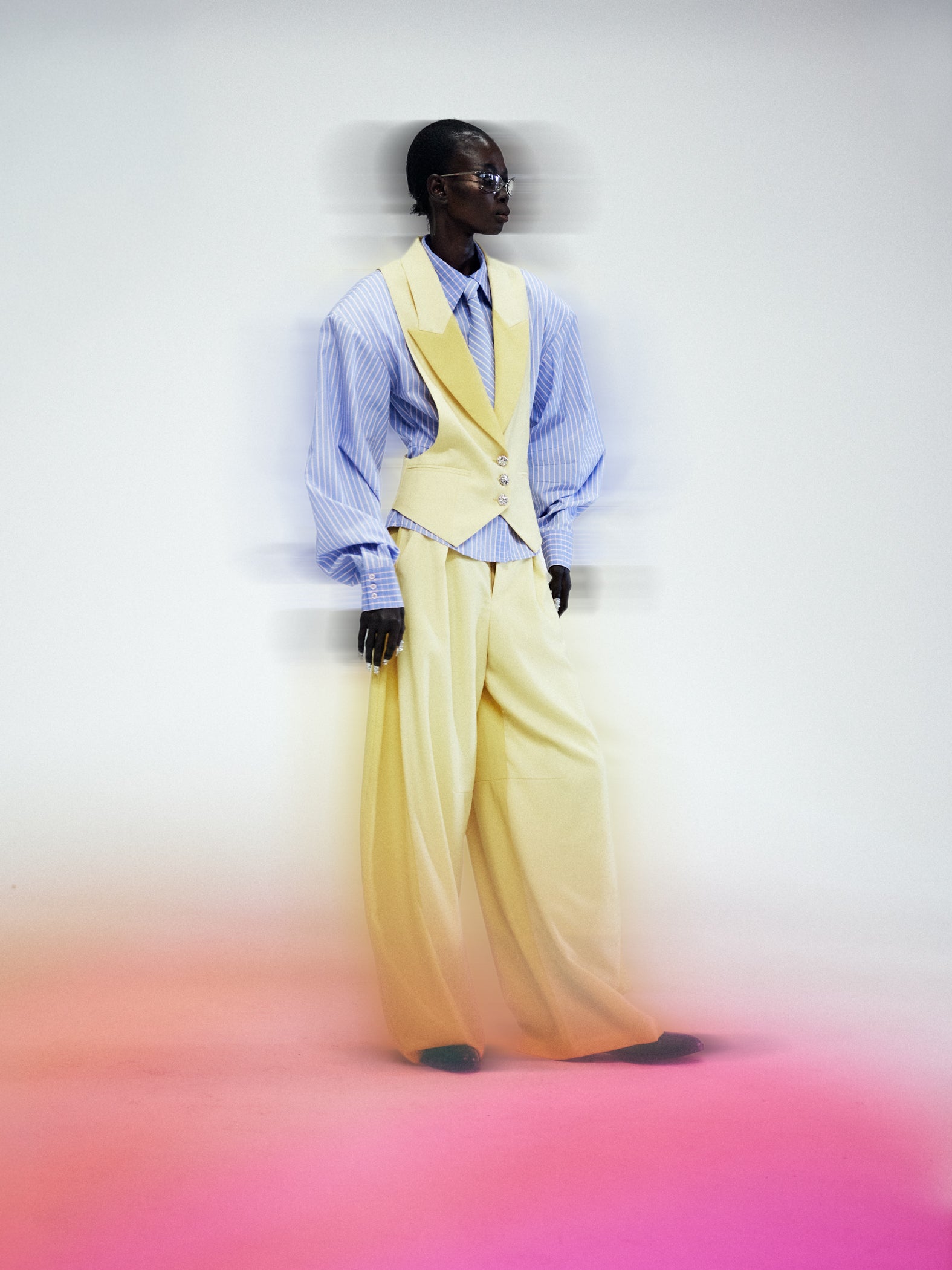
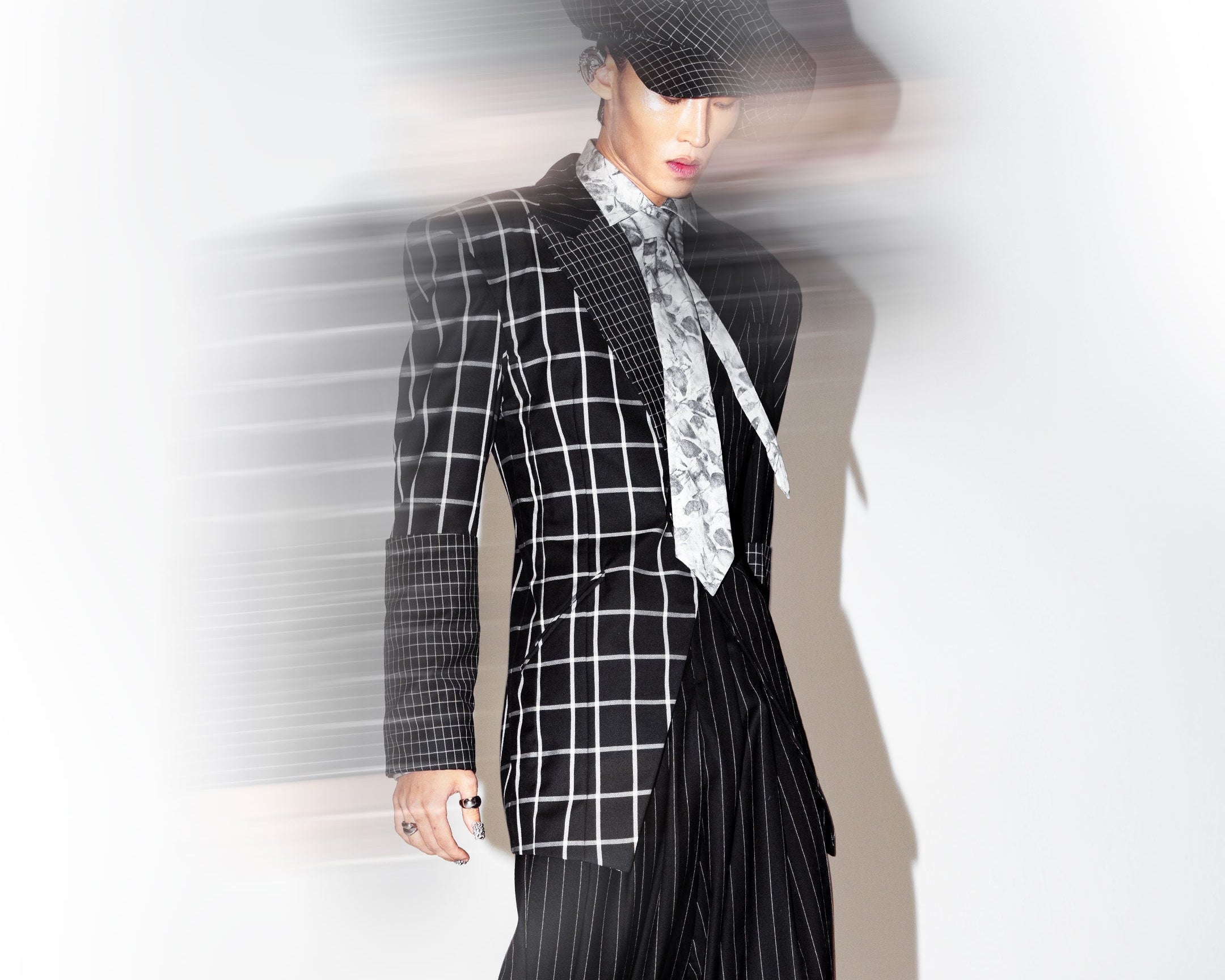
The Numero spread shows Romanov in a look that exemplifies everything SHAO's temporal quadrilogy finale represents: a blue striped shirt treated not as a basic staple but as an architectural form in its own right, paired with trousers featuring windowpane checks that suggest both accounting ledgers from 1975 and digital grids from 2075. This isn't fashion trying to predict the future. This is design asking what happens when your grandparents' wardrobe collides with your grandchildren's closet, and neither timeline wins.

EXPORE: Futures of the Past: Chrome Legacy Collection
The Editorial Validation of Temporal Disruption
Numéro doesn’t feature designers who play it safe. Its decision to spotlight SHAO’s Chrome Legacy recognizes a creator who refuses to treat time as linear or seasonal. Shao Yang isn’t theorizing about temporal aesthetics—she’s working through personal questions of cultural inheritance and technological futures. The collection asks: If my grandparents stepped into a DeLorean, how would they dress for 2075 without abandoning 1975?
Romanov’s striped shirt embodies this collision. Classic shirting traditions meet exaggerated proportions, merging 1970s echoes with post-human silhouettes. The integrated tie becomes part of the garment’s architecture, linking past formality to future utility. Chrome accents gesture toward speculation, while wool, cotton, and denim keep the collection grounded in material reality.
Model as Time Traveler: Taras Romanov's Casting Significance
Taras Romanov brings distinct cultural resonance to this editorial moment. Discovered by Steven Klein and VMAN in 2020’s search for “the next male supers,” he embodies a generation straddling analog memory and digital futurity. His Ukrainian-American background mirrors SHAO’s East-West synthesis, while his dual identity as model and musician (REIGN) reflects the multihyphenate sensibility Yang’s designs are built to support.
When Romanov wears SHAO’s windowpane trousers, he isn’t simply modeling—he’s inhabiting the liminal terrain the collection investigates. Sharp tailoring nods to Savile Row tradition, while exaggerated proportions and chrome details gesture toward bodies and eras still emerging. This is attire for time travelers, and Romanov intuitively performs the role: someone who belongs to 1975, 2025, and 2075 simultaneously.
The Numéro styling amplifies this ambiguity. Slicked-back hair evokes both 1950s corporate polish and cyberpunk rebellion, while theatrical lighting casts shadows reminiscent of film noir and near-future sci-fi. Viewers are never allowed to situate the look in a single era—which is precisely how Yang intended the collection to operate.

Chrome as Cultural Synthesis, Not Futuristic Gimmick
Fashion often uses chrome as shorthand for “the future,” but SHAO rejects that cliché. In Chrome Legacy, reflective leathers, architectural details, and polished accents aren’t predictions—they’re bridges between the high-shine optimism of 1970s disco and speculative futures that may never arrive. Informed by Yang’s Brooklyn upbringing in the ’80s and ’90s, where immigrant heritage and American assimilation overlapped, chrome becomes a material expression of existing between identities and eras. It reflects both where one comes from and where one might go, without choosing either.
The Numéro editorial captures this complexity through its treatment of light. In some shots, chrome elements absorb the environment, grounding the garments in their surroundings; in others, they create stark contrasts that detach the clothing from any specific era. The shifting visual language isn’t incidental—it’s a direct manifestation of Yang’s philosophy: chrome not as futurist gimmick, but as cultural synthesis made material.
Beyond the Editorial Moment
Numéro offers validation and cultural authority, but the true test of SHAO’s temporal design philosophy happens off the page—when real wearers decide whether these garments belong in their lives, not just in an editorial frame. Early signs show Chrome Legacy succeeds in both arenas. Yang’s background in custom suiting ensures the pieces fit and move like real clothing, not theoretical concepts, allowing their temporal complexity to register visually without compromising everyday functionality.
The integrated-tie shirt can move from boardroom formality to casual ease or evening drama, while the windowpane trousers hold their own in both tailored and streetwear contexts. This adaptability reveals Yang’s ability to embed conceptual ambition within garments that remain genuinely wearable. Numéro captures the spectacle, but the clothes themselves deliver the substance—balancing editorial impact with practical utility, and proving that temporal disruption can coexist with reliable construction.
Experience SHAO Bespoke. Designer-led custom tailoring by private appointment in SoHo, NYC. Book a private fitting →


